
最新的SOA Design & Architecture Lab - S90.09免費考試真題
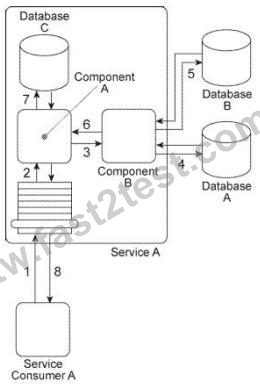
Service Consumer A sends Service A a message containing a business document (1). The
business document is received by Component A, which keeps the business document in
memory and forwards a copy to Component B (3). Component B first writes portions of the
business document to Database A (4).
Component B writes the entire business document to Database B and then uses some of
the data values from the business document as query parameters to retrieve new data from
Database B (5).
Next, Component B returns the new data back to Component A (6), which merges it
together with the original business document it has been keeping in memory and then
writes the combined data to Database C (7). The Service A service capability invoked by
Service Consumer A requires a synchronous request-response data exchange. Therefore,
based on the outcome of the last database update, Service A returns a message with a
success or failure code back to Service Consumer A (8).
Databases A and B are shared and Database C is dedicated to the Service A service
architecture.
There are several problems with this architecture: First, the response time of Database A is
often poor, resulting in Component B taking too much time to provide a response to
Component A.
This results in Component A consuming too many runtime resources while it
holds the business document in memory and it also causes unreasonable delays in
responding to Service Consumer A.
Additionally, Database B is being replaced with a different database product that supports a proprietary file format. This will disable the
current interaction between Component B and the new Database B.
What steps can be taken to solve these problems?
business document is received by Component A, which keeps the business document in
memory and forwards a copy to Component B (3). Component B first writes portions of the
business document to Database A (4).
Component B writes the entire business document to Database B and then uses some of
the data values from the business document as query parameters to retrieve new data from
Database B (5).
Next, Component B returns the new data back to Component A (6), which merges it
together with the original business document it has been keeping in memory and then
writes the combined data to Database C (7). The Service A service capability invoked by
Service Consumer A requires a synchronous request-response data exchange. Therefore,
based on the outcome of the last database update, Service A returns a message with a
success or failure code back to Service Consumer A (8).
Databases A and B are shared and Database C is dedicated to the Service A service
architecture.
There are several problems with this architecture: First, the response time of Database A is
often poor, resulting in Component B taking too much time to provide a response to
Component A.
This results in Component A consuming too many runtime resources while it
holds the business document in memory and it also causes unreasonable delays in
responding to Service Consumer A.
Additionally, Database B is being replaced with a different database product that supports a proprietary file format. This will disable the
current interaction between Component B and the new Database B.
What steps can be taken to solve these problems?
正確答案: B
Our service inventory contains the following three services that provide invoice-related data
access capabilities: Invoice, InvProc, and Proclnv. These services were created at different
times by different project teams and were not required to comply to any design standards.
Therefore each of these services has a different data model for representing invoice data.
Currently each of these three services has one service consumer: Service Consumer A
accesses the Invoice service(1). Service Consumer B (2) accesses the InvProc service,
and Service Consumer C (3) accesses the Proclnv service. Each service consumer
invokes a data access capability of an invoice-related service, requiring that service to
interact with the shared accounting database that is used by all invoice-related services (4,
5, 6).
Additionally, Service Consumer D was designed to access invoice data from the shared
accounting database directly (7). (Within the context of this architecture. Service Consumer
D is labeled as a service consumer because it is accessing a resource that is related to the
illustrated service architectures.)

A project team recently proclaimed that it has successfully applied the Contract
Centralization pattern to the service inventory in which the Invoice service, InvProc service,
and ProcInv service reside. Upon reviewing the previously described architecture you have
doubts that this is true. After voicing your doubts to a manager, you are asked to provide
specific evidence as to why the Contract Centralization is not currently fully applied. Which
of the following statements provides this evidence?
access capabilities: Invoice, InvProc, and Proclnv. These services were created at different
times by different project teams and were not required to comply to any design standards.
Therefore each of these services has a different data model for representing invoice data.
Currently each of these three services has one service consumer: Service Consumer A
accesses the Invoice service(1). Service Consumer B (2) accesses the InvProc service,
and Service Consumer C (3) accesses the Proclnv service. Each service consumer
invokes a data access capability of an invoice-related service, requiring that service to
interact with the shared accounting database that is used by all invoice-related services (4,
5, 6).
Additionally, Service Consumer D was designed to access invoice data from the shared
accounting database directly (7). (Within the context of this architecture. Service Consumer
D is labeled as a service consumer because it is accessing a resource that is related to the
illustrated service architectures.)
A project team recently proclaimed that it has successfully applied the Contract
Centralization pattern to the service inventory in which the Invoice service, InvProc service,
and ProcInv service reside. Upon reviewing the previously described architecture you have
doubts that this is true. After voicing your doubts to a manager, you are asked to provide
specific evidence as to why the Contract Centralization is not currently fully applied. Which
of the following statements provides this evidence?
正確答案: B
Services A, B, and C are non-agnostic task services. Service A and Service B use the
same shared state database to defer their state data at runtime.
An assessment of these three services reveals that each contains some agnostic logic, but
because it is bundled together with the non-agnostic logic, the agnostic logic cannot be
made available for reuse.
The assessment also determines that because Service A and Service B and the shared
state database are each located in physically separate environments, the remote
communication required for Service A and Service B to interact with the shared state
database is causing an unreasonable decrease in runtime performance.

You are asked to redesign this architecture in order to increase the opportunity for agnostic
service logic to be reused and in order to decrease the runtime processing demands so
that performance can be improved. What steps can be taken to achieve these goals?
same shared state database to defer their state data at runtime.
An assessment of these three services reveals that each contains some agnostic logic, but
because it is bundled together with the non-agnostic logic, the agnostic logic cannot be
made available for reuse.
The assessment also determines that because Service A and Service B and the shared
state database are each located in physically separate environments, the remote
communication required for Service A and Service B to interact with the shared state
database is causing an unreasonable decrease in runtime performance.
You are asked to redesign this architecture in order to increase the opportunity for agnostic
service logic to be reused and in order to decrease the runtime processing demands so
that performance can be improved. What steps can be taken to achieve these goals?
正確答案: D
Service A is a task service that is required to carry out a series of updates to a set of
databases in order to complete a task. To perform the database updates Service A must
interact with three other services, each of which provides standardized data access
capabilities.
Service A sends its first update request message to Service B (1), which then responds
with a message containing a success or failure code (2). Service A then sends its second
update request message to Service C (3), which also responds with a message containing
a success or failure code (4). Finally, Service A sends a request message to Service D (5),
which responds with its own message containing a success or failure code (6).

You've been given a requirement that all database updates must either be completed
successfully or not at all. This means that if any of the three response messages received
by Service A contain a failure code, all of the updates carried out until that point must be
reversed. Note that if Service A does not receive a response message back from Services
B, C, or D, it must assume that a failure has occurred. How can this service composition
architecture be changed to fulfill these requirements?
databases in order to complete a task. To perform the database updates Service A must
interact with three other services, each of which provides standardized data access
capabilities.
Service A sends its first update request message to Service B (1), which then responds
with a message containing a success or failure code (2). Service A then sends its second
update request message to Service C (3), which also responds with a message containing
a success or failure code (4). Finally, Service A sends a request message to Service D (5),
which responds with its own message containing a success or failure code (6).
You've been given a requirement that all database updates must either be completed
successfully or not at all. This means that if any of the three response messages received
by Service A contain a failure code, all of the updates carried out until that point must be
reversed. Note that if Service A does not receive a response message back from Services
B, C, or D, it must assume that a failure has occurred. How can this service composition
architecture be changed to fulfill these requirements?
正確答案: B