
最新的Microsoft Designing and Implementing Cloud-Native Applications Using Microsoft Azure Cosmos DB - DP-420免費考試真題
You have the following Azure Resource Manager (ARM) template.

You plan to deploy the template in incremental mode.
For each of the following statements, select Yes if the statement is true. Otherwise, select No.

You plan to deploy the template in incremental mode.
For each of the following statements, select Yes if the statement is true. Otherwise, select No.
正確答案:

Explanation:

You maintain a relational database for a book publisher. The database contains the following tables.

The most common query lists the books for a given authorId.
You need to develop a non-relational data model for Azure Cosmos DB Core (SQL) API that will replace the relational database. The solution must minimize latency and read operation costs.
What should you include in the solution?
The most common query lists the books for a given authorId.
You need to develop a non-relational data model for Azure Cosmos DB Core (SQL) API that will replace the relational database. The solution must minimize latency and read operation costs.
What should you include in the solution?
正確答案: B
說明:(僅 Fast2test 成員可見)
You have an Azure subscription that contains an Azure Cosmos DB for NoSQL account. You create a container and assign the following indexing policy.

You run the queries shown in the following table.

For each of the following statements, select yes if the statement is true. Otherwise, select No NOTE: Each correct selection is worth one point.
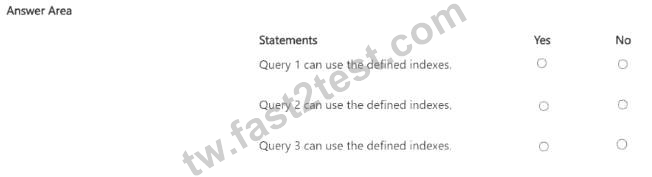
You run the queries shown in the following table.
For each of the following statements, select yes if the statement is true. Otherwise, select No NOTE: Each correct selection is worth one point.
正確答案:

Explanation:

You have an Azure Cosmos OB for NoSQL account configured for global distribution across four regions. At connection time, the SQL SDK needs to identify the optimal endpoint for reading and writing. Which two factors can influence the SDK? Each correct answer presents a complete solution NOTE- Each correct selection is worth one point.
正確答案: A,E
You have an Azure Cosmos DB Core (SQL) API account used by an application named App1.
You open the Insights pane for the account and see the following chart.

Use the drop-down menus to select the answer choice that answers each question based on the information presented in the graphic.
NOTE: Each correct selection is worth one point.

You open the Insights pane for the account and see the following chart.
Use the drop-down menus to select the answer choice that answers each question based on the information presented in the graphic.
NOTE: Each correct selection is worth one point.
正確答案:

Explanation:

Box 1: incorrect connection URLs
400 Bad Request: Returned when there is an error in the request URI, headers, or body. The response body will contain an error message explaining what the specific problem is.
The HyperText Transfer Protocol (HTTP) 400 Bad Request response status code indicates that the server cannot or will not process the request due to something that is perceived to be a client error (for example, malformed request syntax, invalid request message framing, or deceptive request routing).
Box 2: 6 thousand
201 Created: Success on PUT or POST. Object created or updated successfully.
Note:
200 OK: Success on GET, PUT, or POST. Returned for a successful response.
404 Not Found: Returned when a resource does not exist on the server. If you are managing or querying an index, check the syntax and verify the index name is specified correctly.
Reference: https://docs.microsoft.com/en-us/rest/api/searchservice/http-status-codes
You have an Azure Cosmos DB Core (SQL) API account named storage1 that uses provisioned throughput capacity mode.
The storage1 account contains the databases shown in the following table.

The databases contain the containers shown in the following table.

For each of the following statements, select Yes if the statement is true. Otherwise, select No.
NOTE: Each correct selection is worth one point.

The storage1 account contains the databases shown in the following table.
The databases contain the containers shown in the following table.
For each of the following statements, select Yes if the statement is true. Otherwise, select No.
NOTE: Each correct selection is worth one point.
正確答案:

Explanation:

Box 1: No
Four containers with 1000 RU/s each.
Box 2: No
Max 8000 RU/s for db2. 8 containers, so 1000 RU/s for each container.
Box 3: Yes
Max 8000 RU/s for db2. 8 containers, so 1000 RU/s for each container. Can very well add an additional container.
Reference:
https://docs.microsoft.com/en-us/azure/cosmos-db/plan-manage-costs
https://azure.microsoft.com/en-us/pricing/details/cosmos-db/
You need to select the partition key for con-iot1. The solution must meet the IoT telemetry requirements.
What should you select?
What should you select?
正確答案: C
說明:(僅 Fast2test 成員可見)
You have an Azure Cosmos DB account that hosts a single container named Container1. Container1 contains items that include two properties named Tenantld and Userld. Container1 has logical partitions based on the Tenantld property.
You need to configure subpartitioning for Container1 based on the Userld property. The solution must maximize data availability.
What should you do first?
You need to configure subpartitioning for Container1 based on the Userld property. The solution must maximize data availability.
What should you do first?
正確答案: B
You have a container m an Azure Cosmos DB for NoSQL account.
Data update volumes are unpredictable.
You need to process the change teed of the container by using a web app that has multiple instances. The change feed will be processed by using the change feed processor from the Azure Cosmos DB SDK. The multiple instances must share the workload.
Which three actions should you perform? Each correct answer presents part of the solution.
NOTE: Each correct selection is worth one point.
正確答案: B,C,D
You have a container named container1 in an Azure Cosmos DB for NoSQL account named account1.
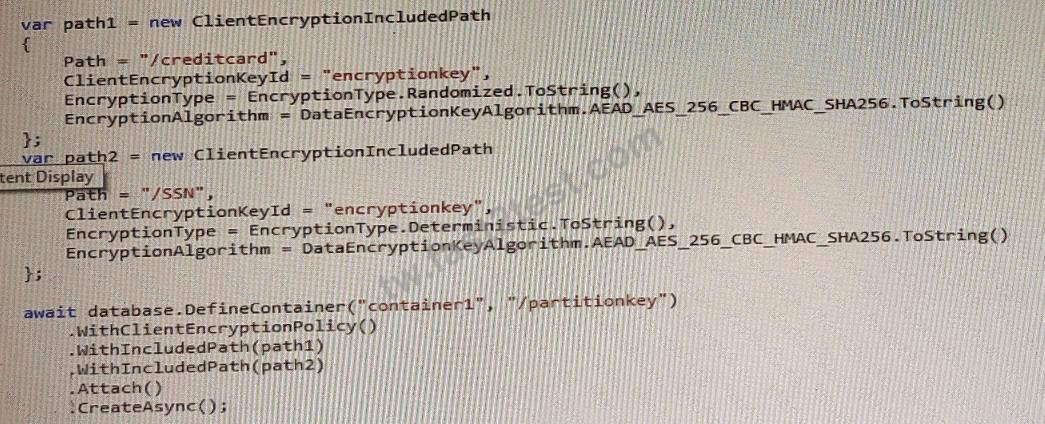
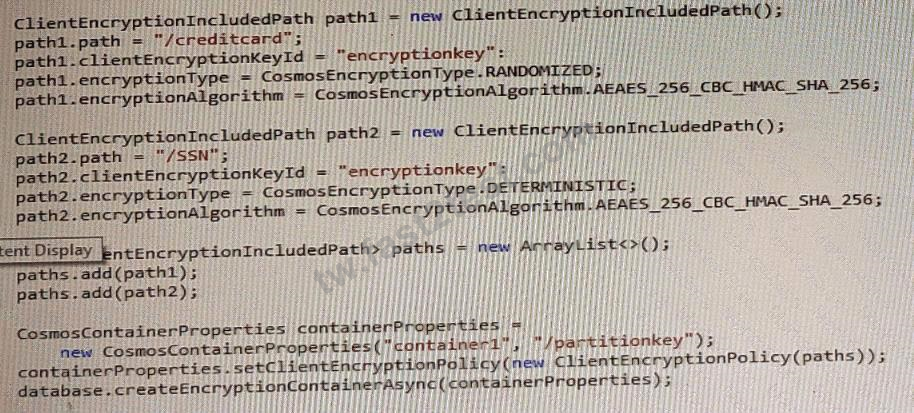
You configure container1 to use Always Encrypted by using an encryption policy as shown in the C# and the Java exhibits. (Click the C# tab to view the encryption policy in C#. Click the Java tab to see the encryption policy in Java.)
For each of the following statements, select Yes if the statement is true. Otherwise, select No.
NOTE: Each correct selection is worth one point.
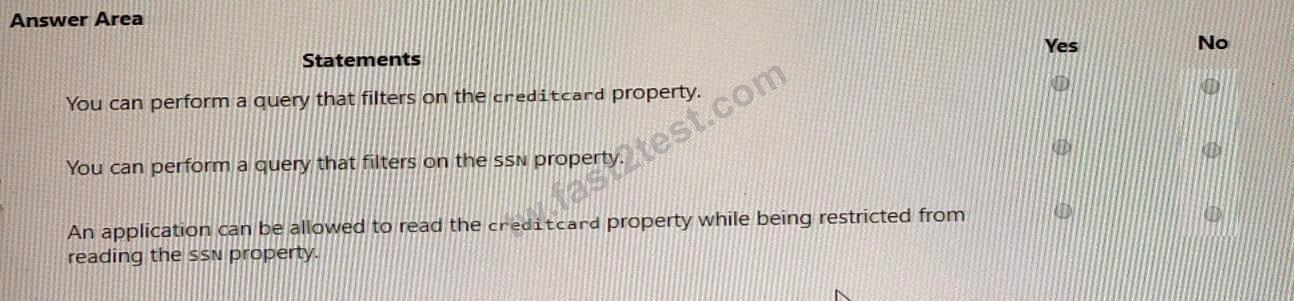
You configure container1 to use Always Encrypted by using an encryption policy as shown in the C# and the Java exhibits. (Click the C# tab to view the encryption policy in C#. Click the Java tab to see the encryption policy in Java.)
For each of the following statements, select Yes if the statement is true. Otherwise, select No.
NOTE: Each correct selection is worth one point.
正確答案:

Explanation:
According to the Azure Cosmos DB documentation1, Always Encrypted is a feature designed to protect sensitive data, such as credit card numbers or national identification numbers, stored in Azure Cosmos DB.
Always Encrypted allows clients to encrypt sensitive data inside client applications and never reveal the encryption keys to the database.
To use Always Encrypted, you need to define an encryption policy for each container that specifies which properties should be encrypted and which data encryption keys (DEK) should be used. The DEKs are stored in Azure Cosmos DB and are wrapped by customer-managed keys (CMK) that are stored in Azure Key Vault.
Based on the encryption policy shown in the exhibits, the creditcard property is encrypted with a DEK named dek1, and the SSN property is encrypted with a DEK named dek2. Both DEKs are wrapped by a CMK named cmk1.
To answer your statements:
You can perform a query that filters on the creditcard property = No. This is because the creditcard property is encrypted and cannot be used for filtering or sorting operations1.
You can perform a query that filters on the SSN property = No. This is also because the SSN property is encrypted and cannot be used for filtering or sorting operations1.
An application can be allowed to read the creditcard property while being restricted from reading the SSN property = Yes. This is possible by using different CMKs to wrap different DEKs and applying access policies on the CMKs in Azure Key Vault. For example, if you use cmk2 to wrap dek2 instead of cmk1, you can grant an application access to cmk1 but not cmk2, which means it can read the creditcard property but not the SSN property2.