
最新的Microsoft Provisioning SQL Databases - 070-765免費考試真題
You need to optimize SRV1.
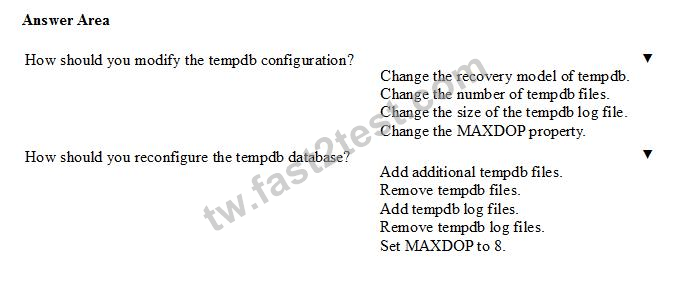
What configuration changes should you implement? To answer, select the appropriate option from each list in the answer area.
What configuration changes should you implement? To answer, select the appropriate option from each list in the answer area.
正確答案:

Explanation:
From the scenario: SRV1 has 16 logical cores and hosts a SQL Server instance that supports a mission-critical application. The application hasapproximately 30,000 concurrent users and relies heavily on the use of temporary tables.
Box 1: Change the size of the tempdb log file.
The size and physical placement of the tempdb database can affect the performance of a system. For example, if the size that is defined for tempdb is too small, part of the system-processing load may be taken up with autogrowing tempdb to the size required to support the workload every time you restart the instance of SQL Server. You can avoid this overhead by increasing the sizes of the tempdb data and log file.
Box 2: Add additional tempdb files.
Create as many files as needed to maximize disk bandwidth. Using multiple files reduces tempdb storage contention and yields significantly better scalability. However, do not create too many files because this can reduce performance and increase management overhead. As a general guideline, create one data file for each CPU on the server (accounting for any affinity mask settings) and then adjust the number of files up or down as necessary.
Topic 2, Contoso, Ltd Case Study
Background
You are the database administrator for Contoso, Ltd. The company has 200 offices around the world. The company has corporate executives that are located in offices in London, New York, Toronto, Sydney, and Tokyo.
Contoso, Ltd. has a Microsoft Azure SQL Database environment. You plan to deploy a new Azure SQL Database to support a variety of mobile applications and public websites.
The company is deploying a multi-tenant environment. The environment will host Azure SQL Database instances. The company plans to make the instances available to internal departments and partner companies. Contoso is in the final stages of setting up networking and communications for the environment.
Existing Contoso and Customer instances need to be migrated to Azure virtual machines (VM) according to the following requirements:
The company plans to deploy a new order entry application and a new business intelligence and analysis application. Each application will be supported by a new database. Contoso creates a new Azure SQL database named Reporting. The database will be used to support the company's financial reporting requirements. You associate the database with the Contoso Azure Active Directory domain.
Each location database for the data entry application may have an unpredictable amount of activity. Data must be replicated to secondary databases in Azure datacenters in different regions.
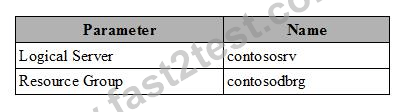
To support the application, you need to create a database named contosodb1 in the existing environment.
Objects
Database
The contosodb1 database must support the following requirements:
Application
For the business intelligence application, corporate executives must be able to view all data in near real-time with low network latency.
Contoso has the following security, networking, and communications requirements:
You have Microsoft SQL Server on a Microsoft azure virtual machine that has 12 databases.
All database files are in the same Azure Blob storage account.
You need to receive an email notification if I/O operations to the database files exceed 800 MB/s for more than five minutes.
Solution: You run the Get-Counter cmdlet and specify the -counter '\physicaldisk:disk write/sec' parameter.
Does this meet the goal?
All database files are in the same Azure Blob storage account.
You need to receive an email notification if I/O operations to the database files exceed 800 MB/s for more than five minutes.
Solution: You run the Get-Counter cmdlet and specify the -counter '\physicaldisk:disk write/sec' parameter.
Does this meet the goal?
正確答案: A
You have a Microsoft SQL server that manages all of your databases.
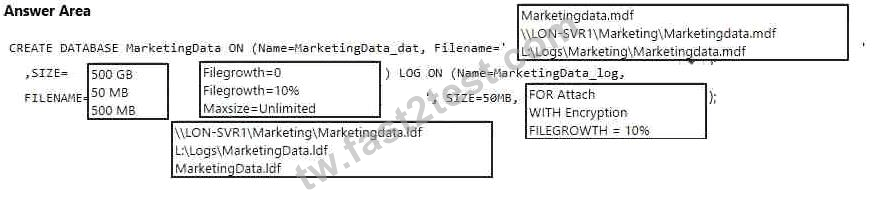
You must create a database named Marketing Data. The database will initially consume 400 megabytes (MB) of storage and will grow by one percent per year.
The database file must be stored on the Marketing share of the Lon-SVR1 server. The file must not automatically increase in size. Log files must be stored on the L drive of the SQL Server machine in a folder named Logs.
You need to create the MarketingData database.
How should you complete the Transact-SQL statement? To answer, select the appropriate Transact-SQL segments in the answer area.
NOTE: Each correct selection is worth one point.
You must create a database named Marketing Data. The database will initially consume 400 megabytes (MB) of storage and will grow by one percent per year.
The database file must be stored on the Marketing share of the Lon-SVR1 server. The file must not automatically increase in size. Log files must be stored on the L drive of the SQL Server machine in a folder named Logs.
You need to create the MarketingData database.
How should you complete the Transact-SQL statement? To answer, select the appropriate Transact-SQL segments in the answer area.
NOTE: Each correct selection is worth one point.
正確答案:
Explanation:
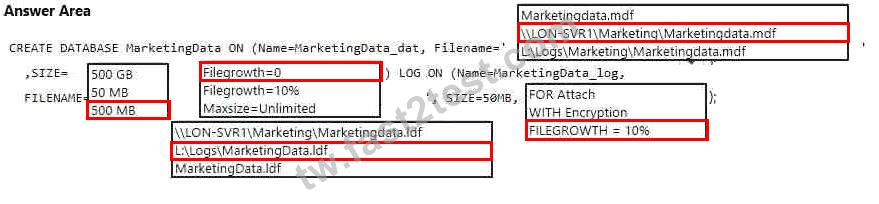
Box 1: \\LON-SRV1\Marketing\Marketingdata.mdf
The database file must be stored on the Marketing share of the Lon-SVR1 server.
Box 2: 500 MB
Initial size is 400 MB, with an annual 1% increase in size.
Box 3: Filegrowth=0
The file must not automatically increase in size.
Box 4: L:\Logs\Marketing\Marketingdata.ldf
Log files must be stored on the L drive of the SQL Server machine in a folder named Logs.
Box 5: Filegrowth = 10%
The log file must be able to grow.
References:
https://docs.microsoft.com/en-us/sql/t-sql/statements/create-database-transact-sql?view=sql-server-2017
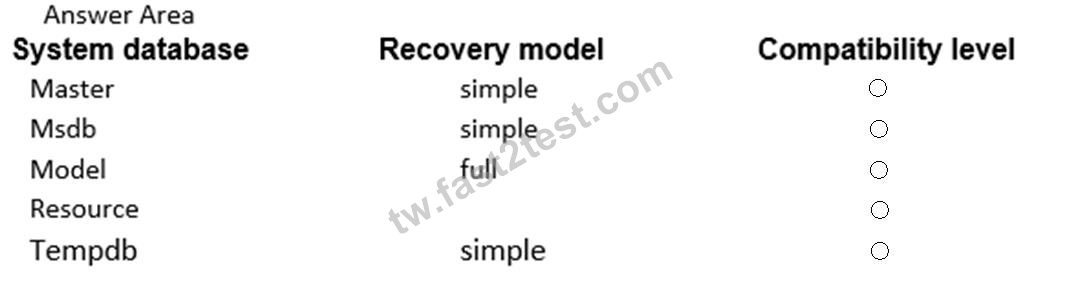
A company has an on-premises Microsoft SQL Server 2016 environment. All futures databases must meet the following requirements:
The recovery model must be set to simple.
The compatibility level must be set to SQL server 2014 (120).
Your need to configure the SQL server 2016 environment.
In the table below, identify the database you must modify for each requirement.
The recovery model must be set to simple.
The compatibility level must be set to SQL server 2014 (120).
Your need to configure the SQL server 2016 environment.
In the table below, identify the database you must modify for each requirement.
正確答案:
Explanation:
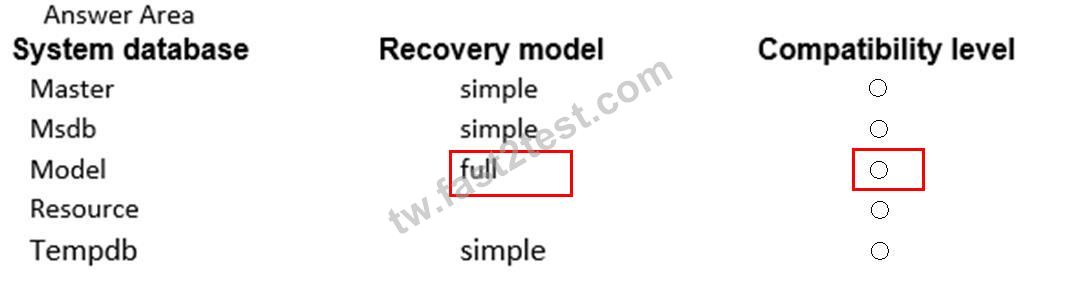
Model: Change from full to simple Recovery Model
Newly created user databases use the same recovery model as the model database.
The model database is used as the template for all databases created on an instance of SQL Server. Because tempdb is created every time SQL Server is started, the model database must always exist on a SQL Server system. The entire contents of the model database, including database options, are copied to the new database.
Model: Set compatibility level to 120
For all installations of SQL Server, the default compatibility level is set to the version of the Database Engine. Databases are set to this level unless the model database has a lower compatibility level.
References:
https://docs.microsoft.com/en-us/sql/relational-databases/databases/model-database?view=sql-server-2017
https://docs.microsoft.com/en-us/sql/t-sql/statements/alter-database-transact-sql-compatibility-level?view=sql-server-2017
You have been hired as a Database Consultant by ABC.com to design a SQL Server 2014 database solution.
You are tasked with designing a scale-out and high-availability SQL Server 2014 Online Transaction Processing (OLTP) database solution that will maintain copies of data across two server instances.
Your solution must provide scale-out of read operations by distributing the reads from clients across two SQL Server 2014 nodes. The data in both SQL Server nodes needs to be indexed.
What should you include in your solution?
You are tasked with designing a scale-out and high-availability SQL Server 2014 Online Transaction Processing (OLTP) database solution that will maintain copies of data across two server instances.
Your solution must provide scale-out of read operations by distributing the reads from clients across two SQL Server 2014 nodes. The data in both SQL Server nodes needs to be indexed.
What should you include in your solution?
正確答案: B
說明:(僅 Fast2test 成員可見)
A new Azure Active Directory security principal named [email protected] should have access to select all current and future objects in the Reporting database. You should not grant the principal any other permissions. You should use your Active Directory Domain Services (AD DS) account to authenticate to the Azure SQL database.
You need to create the new security principal.
Which three actions should you perform in sequence? To answer, move the appropriate actions from the list of actions to the answer area and arrange them in the correct order.

You need to create the new security principal.
Which three actions should you perform in sequence? To answer, move the appropriate actions from the list of actions to the answer area and arrange them in the correct order.
正確答案:
Explanation:
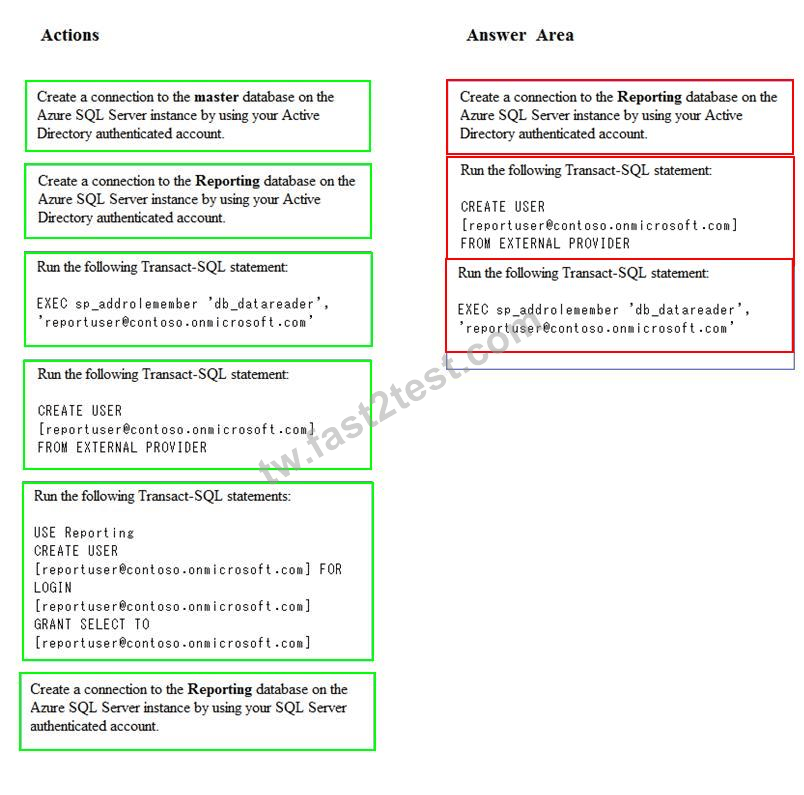
Step 1:
To provision an Azure AD-based contained database user (other than the server administrator that owns the database), connect to the database (here the Reporting database) with an Azure AD identity (not with a SQL Server account) that has access to the database.
Step 2: CREATE USER ... FROM EXTERNAL PROVIDER
To create an Azure AD-based contained database user (other than the server administrator that owns the database), connect to the database with an Azure AD identity, as a user with at least the ALTER ANY USER permission. Then use the following Transact-SQL syntax:
CREATE USER <Azure_AD_principal_name>
FROM EXTERNAL PROVIDER;
Step 3:
Grant the proper reading permissions.
References:
https://docs.microsoft.com/en-us/azure/sql-database/sql-database-aad-authentication
You are migrating an on-premises Microsoft SQL Server virtual machine (VM) to an Azure IaaS VM.
The following chart shows current peak IOPS per hour over the course of a day:
You have a single-server on-premises Microsoft SQL Server deployment.
You must migrate the environment to an Azure virtual machine (VM). You must minimize costs while maintaining the same level of performance as the on-premises SQL environment.
You need to evaluate the number and types of read/write operations for the existing deployment.
Which tool should you use?
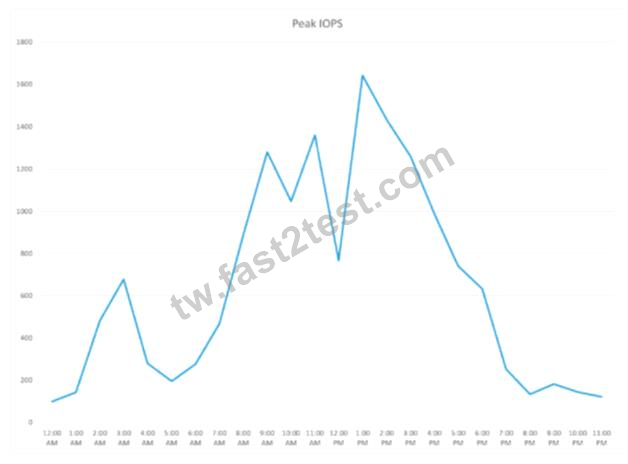
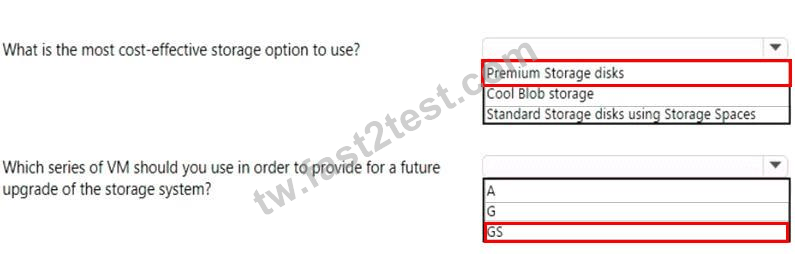
The number of IOPS per hour is expected to peak at 20 times the current value in the future.
Use the drop-down menus to select the answer choice that answers each question based on the information presented in the graphic.
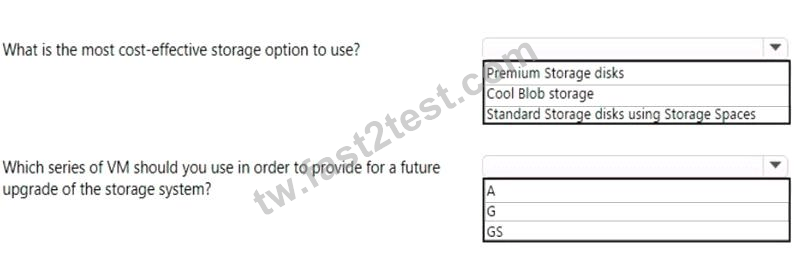
The following chart shows current peak IOPS per hour over the course of a day:
You have a single-server on-premises Microsoft SQL Server deployment.
You must migrate the environment to an Azure virtual machine (VM). You must minimize costs while maintaining the same level of performance as the on-premises SQL environment.
You need to evaluate the number and types of read/write operations for the existing deployment.
Which tool should you use?
The number of IOPS per hour is expected to peak at 20 times the current value in the future.
Use the drop-down menus to select the answer choice that answers each question based on the information presented in the graphic.
正確答案:
Note: This question is part of a series of questions that present the same scenario. Each question in the series contains a unique solution that might meet the stated goals. Some question sets might have more than one correct solution, while others might not have a correct solution.
After you answer a question in this sections, you will NOT be able to return to it. As a result, these questions will not appear in the review screen.
You have Microsoft SQL Server on a Microsoft Azure virtual machine that has a database named DB1.
You discover that DB1 experiences WRITE_LOG waits that are longer than 50 ms.
You need to reduce the WRITE_LOG wait time.
Solution: Add additional data files to DB1.
Does this meet the goal?
After you answer a question in this sections, you will NOT be able to return to it. As a result, these questions will not appear in the review screen.
You have Microsoft SQL Server on a Microsoft Azure virtual machine that has a database named DB1.
You discover that DB1 experiences WRITE_LOG waits that are longer than 50 ms.
You need to reduce the WRITE_LOG wait time.
Solution: Add additional data files to DB1.
Does this meet the goal?
正確答案: A
說明:(僅 Fast2test 成員可見)
You use Microsoft SQL Server 2014 to develop a database application. You need to create an object that meets the following requirements:
Which object should you use?
Which object should you use?
正確答案: B
說明:(僅 Fast2test 成員可見)
You administer a SQL Server 2014 server that contains a database named SalesDb. SalesDb contains a schema named Customers that has a table named Regions. A user named UserA is a member of a role named Sales. UserA is granted the Select permission on the Regions table. The Sales role is granted the Select permission on the Customers schema.
You need to ensure that the following requirements are met:
Which Transact-SQL statement should you use?
You need to ensure that the following requirements are met:
Which Transact-SQL statement should you use?
正確答案: E
說明:(僅 Fast2test 成員可見)
You are the database administrator for your company. Your company has one main office and two branch offices. You plan to create three databases named DB1, DB2, and DB3 that will be hosted on one Azure SQL Database server. You have the following requirements:
The main office must be able to connect to all three databases.
The branch offices must be able to connect to DB2 and DB3.
The branch offices must not be able to access DB1.
You need to configure transparent data encryption (TDE) for DB1. Which two actions should you perform?
Each correct answer presents part of the solution.
The main office must be able to connect to all three databases.
The branch offices must be able to connect to DB2 and DB3.
The branch offices must not be able to access DB1.
You need to configure transparent data encryption (TDE) for DB1. Which two actions should you perform?
Each correct answer presents part of the solution.
正確答案: A,E
說明:(僅 Fast2test 成員可見)
Background
You manage the Microsoft SQL Server environment for a company that manufactures and sells automobile parts.
The environment includes the following servers: SRV1 and SRV2. SRV1 has 16 logical cores and hosts a SQL Server instance that supports a mission-critical application. The application has approximately 30,000 concurrent users and relies heavily on the use of temporary tables.
The environment also includes the following databases: DB1, DB2, and Reporting. The Reporting database is protected with Transparent Data Encryption (TDE). You plan to migrate this database to a new server. You detach the database and copy it to the new server.
You are performing tuning on a SQL Server database instance. The application which uses the database was written using an object relationship mapping (ORM) tool which maps tables as objects within the application code. There are 30 stored procedures that are regularly used by the application.
After reviewing the plan cache you have identified that a large number of simple queries are using parallelism, and that execution plans are not being kept in the plan cache for very long.
You review the properties of the instance (Click the Exhibit button).
Exhibit:
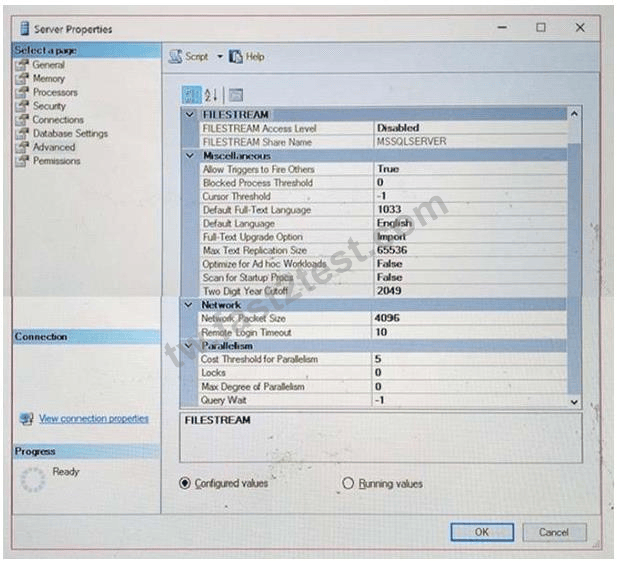
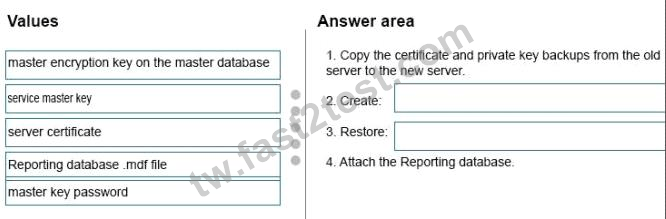
You need to restore the Reporting database to SRV2. What should you do? To answer, drag the appropriate options to the correct locations. Each option may be used once, more than once, or not at all. You may need to drag the split bar between panes or scroll to view content.
Select and Place:
You manage the Microsoft SQL Server environment for a company that manufactures and sells automobile parts.
The environment includes the following servers: SRV1 and SRV2. SRV1 has 16 logical cores and hosts a SQL Server instance that supports a mission-critical application. The application has approximately 30,000 concurrent users and relies heavily on the use of temporary tables.
The environment also includes the following databases: DB1, DB2, and Reporting. The Reporting database is protected with Transparent Data Encryption (TDE). You plan to migrate this database to a new server. You detach the database and copy it to the new server.
You are performing tuning on a SQL Server database instance. The application which uses the database was written using an object relationship mapping (ORM) tool which maps tables as objects within the application code. There are 30 stored procedures that are regularly used by the application.
After reviewing the plan cache you have identified that a large number of simple queries are using parallelism, and that execution plans are not being kept in the plan cache for very long.
You review the properties of the instance (Click the Exhibit button).
Exhibit:
You need to restore the Reporting database to SRV2. What should you do? To answer, drag the appropriate options to the correct locations. Each option may be used once, more than once, or not at all. You may need to drag the split bar between panes or scroll to view content.
Select and Place:
正確答案:
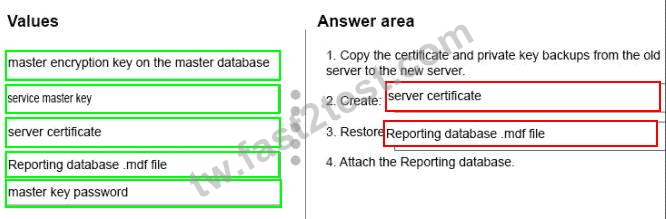
Explanation:
Step 2: Create: server certificate
Recreate the server certificate by using the original server certificate backup file.
Note: The password must be the same as the password that was used when the backup was created.
Step 3: Restore: Reporting database .mdf file.
-- Attach the database that is being moved.
-- The path of the database files must be the location where you have stored the database files.
Example:
CREATE DATABASE [CustRecords] ON
( FILENAME = N'C:\Program Files\Microsoft SQL Server\MSSQL13.MSSQLSERVER\MSSQL\DATA
\CustRecords.mdf' ),
( FILENAME = N'C:\Program Files\Microsoft SQL Server\MSSQL13.MSSQLSERVER\MSSQL\DATA
\CustRecords_log.LDF' )
FOR ATTACH ;
GO
From scenario: The Reporting database is protected with Transparent Data Encryption (TDE). You plan to migrate this database to a new server. You detach the database and copy it to the new server.
References:
https://docs.microsoft.com/en-us/sql/relational-databases/security/encryption/move-a-tdeprotected-database-to-another-sql-server
You administer a Microsoft SQL Server 2014 database.
The database contains a Product table created by using the following definition:
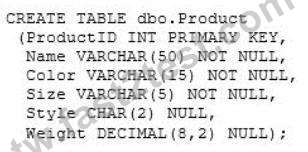
You need to ensure that the minimum amount of disk space is used to store the data in the Product table.
What should you do?
The database contains a Product table created by using the following definition:
You need to ensure that the minimum amount of disk space is used to store the data in the Product table.
What should you do?
正確答案: B
You administer two Microsoft SQL Server 2014 servers. Each server resides in a different, untrusted domain.
You plan to configure database mirroring.
You need to be able to create database mirroring endpoints on both servers.
What should you do?
You plan to configure database mirroring.
You need to be able to create database mirroring endpoints on both servers.
What should you do?
正確答案: C
說明:(僅 Fast2test 成員可見)