
最新的Microsoft Implementing Microsoft Azure Infrastructure Solutions - 070-533免費考試真題
HOTSPOT
You manage two cloud services named Service1 and Service2. The development team updates the code for each application and notifies you that the services are packaged and ready for deployment.
Each cloud service has specific requirements for deployment according to the following table.
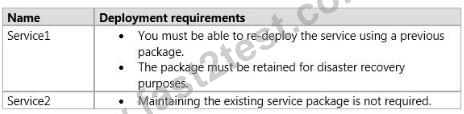
In the table below, identify the deployment method for each service. Make only one selection in each column.
You manage two cloud services named Service1 and Service2. The development team updates the code for each application and notifies you that the services are packaged and ready for deployment.
Each cloud service has specific requirements for deployment according to the following table.
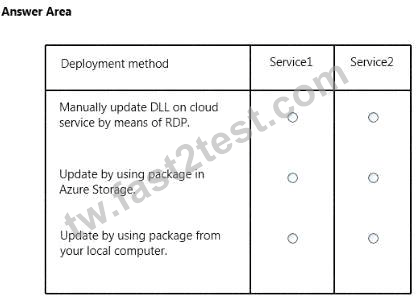
In the table below, identify the deployment method for each service. Make only one selection in each column.
正確答案:
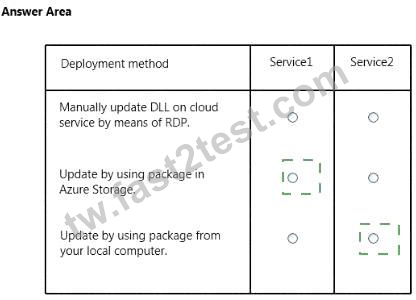
Explanation
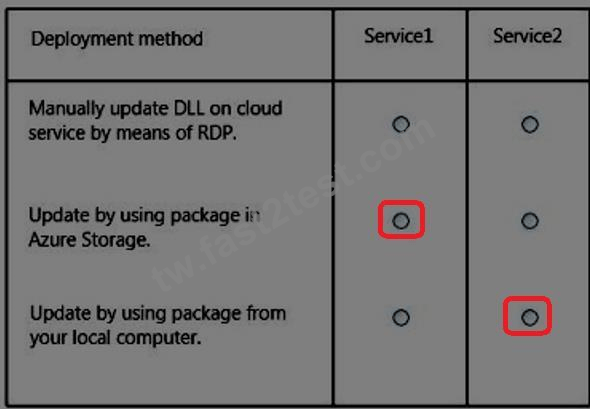
* Service 1
As the package must be retained we should deploy it through the Azure Storage cloud.
* Service 2
As maintaining the existing storage package is not required we can deploy the package locally.
*Azure service package
Whenever you want to deploy your application to a Cloud Service you'll be creating a Service Package and upload it, together with the Service Configuration to a deployment in a Cloud Service. These two artifacts are what makes up a Cloud Service deployment.
Note: This question is part of a series of questions that present the same scenario. Each question in the series contains a unique solution that might meet the stated goals. Some question sets might have more than one correct solution, while others might not have a correct solution.
After you answer a question in this sections, you will NOT be able to return to it. As a result, these questions will not appear in the review screen.
A company has an Azure subscription and plans to deploy virtual machines (VMS), The company needs to use an Azure Active Directory Domain Services (Azure AD DS) domain with the VMS.
You need to ensure that you can join the VMS to the Azure AD DS domain.
Solution: Create an on-premises AD DS domain.
Does the solution meet the goal?
After you answer a question in this sections, you will NOT be able to return to it. As a result, these questions will not appear in the review screen.
A company has an Azure subscription and plans to deploy virtual machines (VMS), The company needs to use an Azure Active Directory Domain Services (Azure AD DS) domain with the VMS.
You need to ensure that you can join the VMS to the Azure AD DS domain.
Solution: Create an on-premises AD DS domain.
Does the solution meet the goal?
正確答案: A
說明:(僅 Fast2test 成員可見)
A company plans to deploy Linux virtual machines (VM) in Azure.
The VM configuration and applications must be managed automatically.
You need to propose a solution to configure and manage the VMs.
What should you recommend?
The VM configuration and applications must be managed automatically.
You need to propose a solution to configure and manage the VMs.
What should you recommend?
正確答案: D
A company plans to deploy Linux virtual machines (VM) in Azure.
The VM configuration and applications must be managed automatically.
You need to propose a solution to configure and manage the VMs.
What should you recommend?
The VM configuration and applications must be managed automatically.
You need to propose a solution to configure and manage the VMs.
What should you recommend?
正確答案: D
說明:(僅 Fast2test 成員可見)
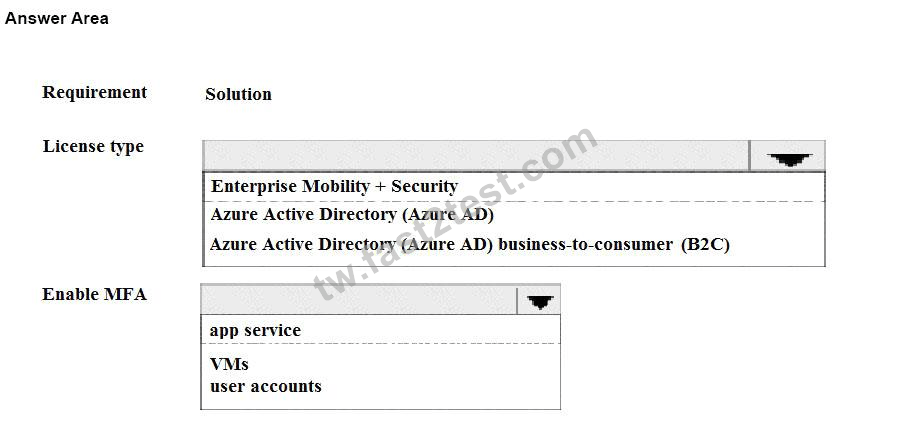
A company uses Azure to host virtual machines (VMs) and web apps. You have the following web apps:
App1 and App2. You deploy the web apps as app services.
You need to ensure that you can enable multi-factor authentication (MFA) for App1 and App2.
What solution should you implement for each requirement? To answer, select the appropriate option in the answer are.
NOTE: Each correct selection is worth one point.
App1 and App2. You deploy the web apps as app services.
You need to ensure that you can enable multi-factor authentication (MFA) for App1 and App2.
What solution should you implement for each requirement? To answer, select the appropriate option in the answer are.
NOTE: Each correct selection is worth one point.
正確答案:
Explanation

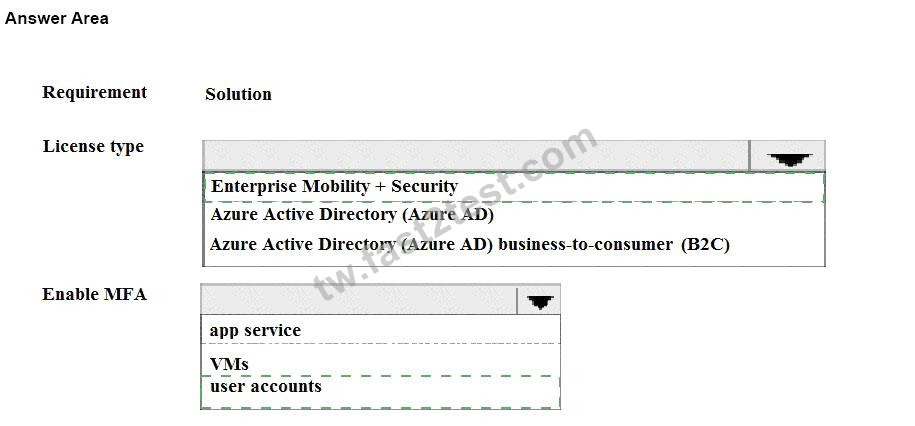
Box 1: Enterprise Mobility + Security
The Enterprise Mobility Suite (EMS) subscription, includes Azure AD Premium, which include Multi-factor Authentication feature.
Box 2: user accounts
Configure the mobile app settings in the Azure Multi-Factor Authentication Server References:
https://blogs.technet.microsoft.com/hybridcloudbp/2016/08/19/hybrid-cloud-identity-part-3-multi-factor-authent
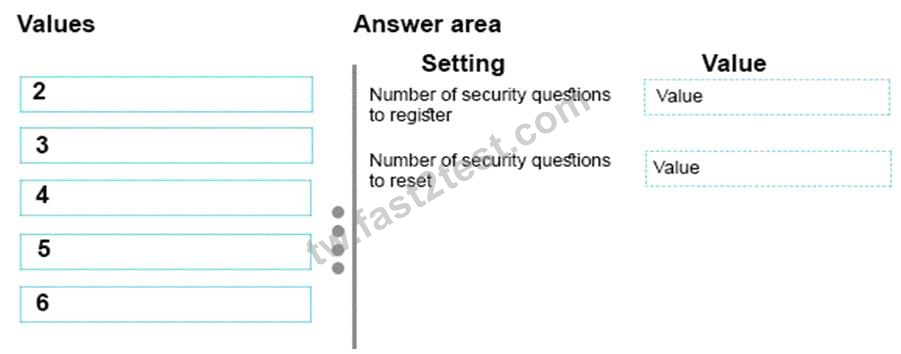
You plan to enable self-service password reset (SSRP) for users in Azure Active Directory (Azure AD). You have the following requirements:
* Users must configure the maximum number of security questions to register for SSPR.
* Users must be prompted with the least number of security questions to perform a password reset.
* You need to configure SSPR.
How should you configure the security questions? To answer, drag the appropriate values to the correct settings. Each value may be used once, more than once, or not at all. You may need to drag the split bar between panes or scroll to view content.
NOTE: Each correct selection is worth one point.
* Users must configure the maximum number of security questions to register for SSPR.
* Users must be prompted with the least number of security questions to perform a password reset.
* You need to configure SSPR.
How should you configure the security questions? To answer, drag the appropriate values to the correct settings. Each value may be used once, more than once, or not at all. You may need to drag the split bar between panes or scroll to view content.
NOTE: Each correct selection is worth one point.
正確答案:
Explanation
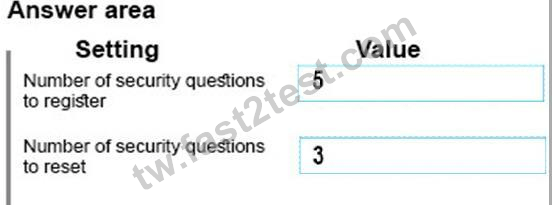
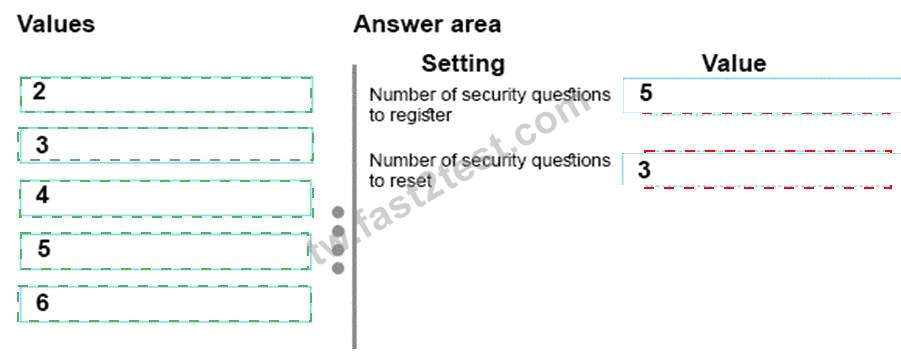
Q: Is it possible to set a minimum limit of security questions for registration and reset?
A: Yes, one limit can be set for registration and another for reset. Three to five security questions can be required for registration, and three to five questions can be required for reset.
References:
https://docs.microsoft.com/en-us/azure/active-directory/authentication/active-directory-passwords-faq
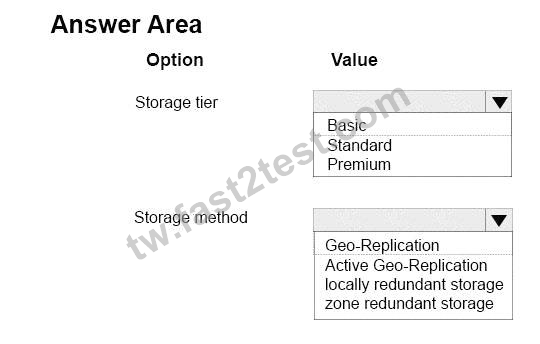
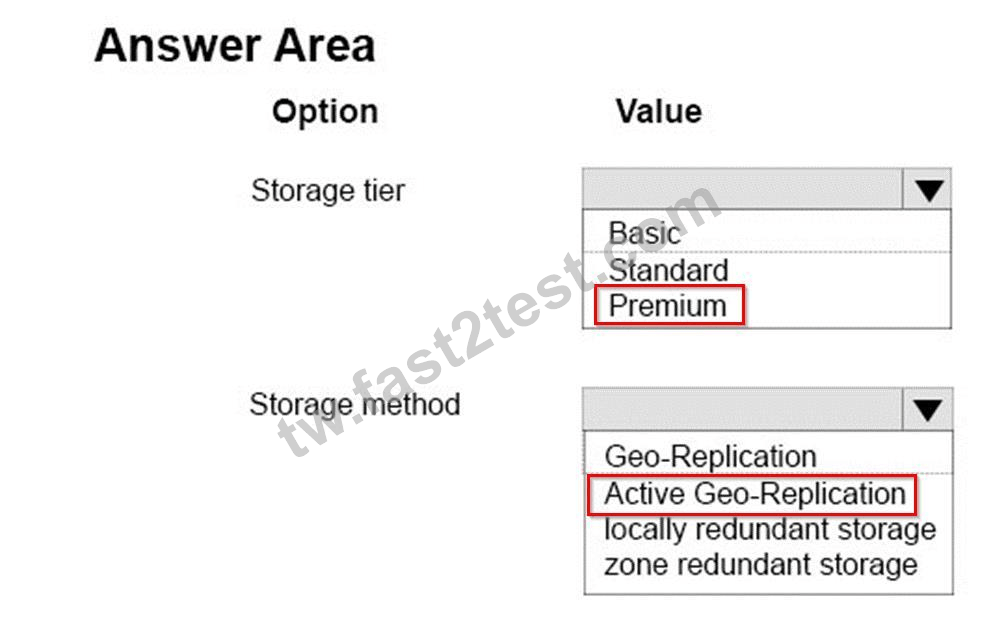
You plan to deploy an Azure SQL Database instance.
After deployment, the solution must meet the following requirements:
- You must be able to restore the database to any point in time for the last 30 days.
- In the event of a restore, data must be recovered by using the fastest available method.
- SQL backups must be stored in up four secondary regions.
- You must minimize costs when configuring the databases.
You need to configure the secondary databases.
Which storage tier and method should you use? To answer, select the appropriate options in the answer area.
NOTE: Each correct selection is worth one point.
After deployment, the solution must meet the following requirements:
- You must be able to restore the database to any point in time for the last 30 days.
- In the event of a restore, data must be recovered by using the fastest available method.
- SQL backups must be stored in up four secondary regions.
- You must minimize costs when configuring the databases.
You need to configure the secondary databases.
Which storage tier and method should you use? To answer, select the appropriate options in the answer area.
NOTE: Each correct selection is worth one point.
正確答案:
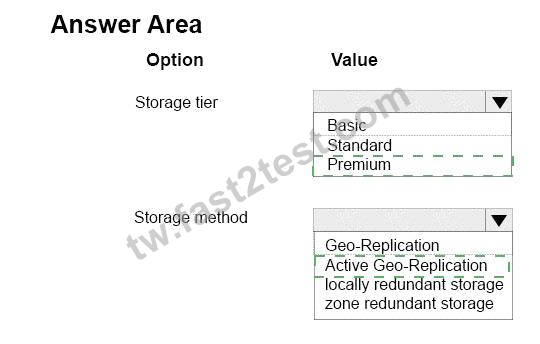
Explanation
A company uses Azure to host virtual machines and web app.
A Line of Business application that turns on a VM must use encrypted storage.
You need to ensure that the VMs support the LOB application.
What should you do?
A Line of Business application that turns on a VM must use encrypted storage.
You need to ensure that the VMs support the LOB application.
What should you do?
正確答案: D
說明:(僅 Fast2test 成員可見)